Beja Airport
Portugal's only airport in the Alentejo region, serving as a dual-use civil and military facility with a focus on business aviation and aircraft maintenance.

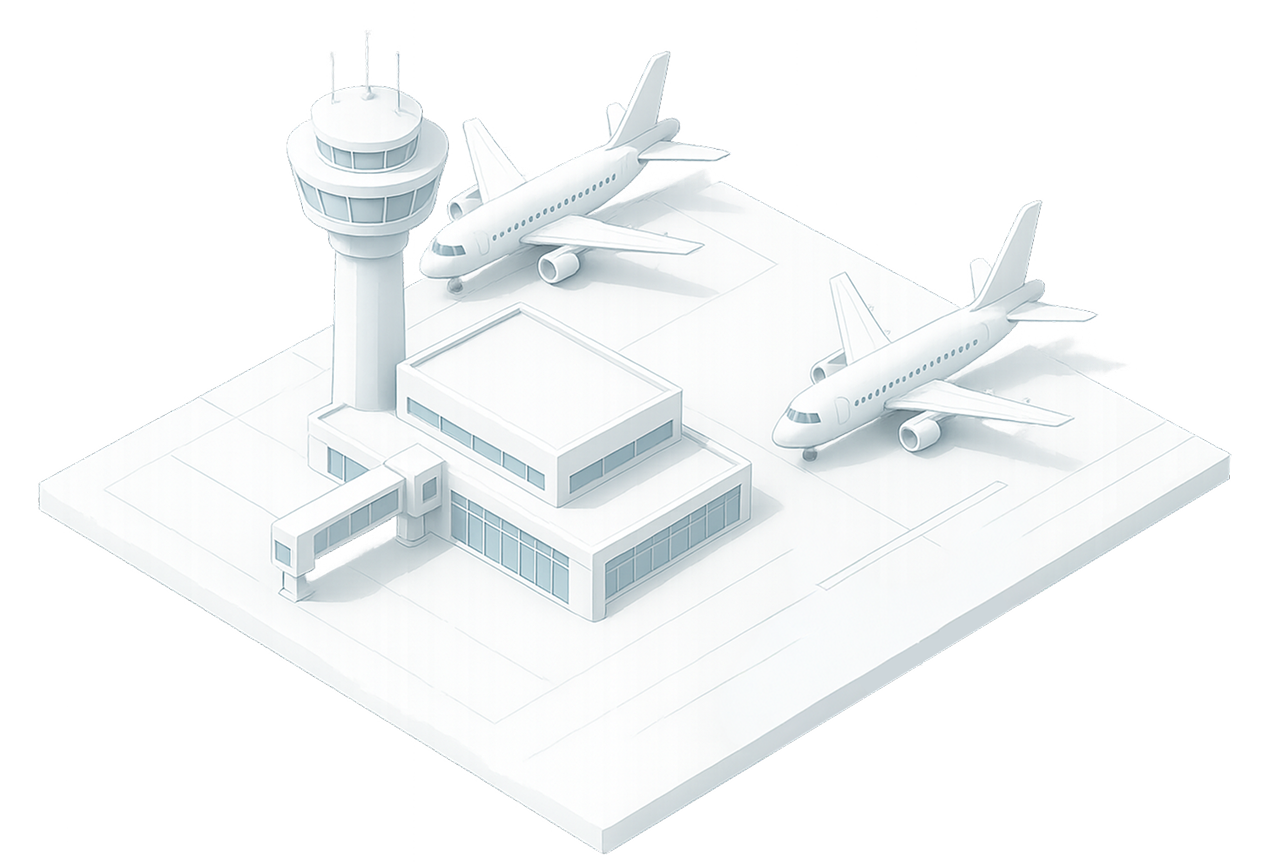

Overview of the Airport
Beja Airport (BYJ) is located 9 km northwest of Beja in the Alentejo region, 150 km from Lisbon and 120 km from Faro. Opened for civilian flights in 2011, it operates as a joint civil-military airport, supporting business aviation, cargo, and aircraft maintenance operations.
38.07889, -7.93250
Growth Trend
Cargo and maintenance operations have grown steadily, while passenger traffic remains limited due to lack of scheduled flights.

Employment
350
Workers include airport staff, ground services, maintenance crews, and military personnel.

Global Ranking
Market Share of Major Airlines
Capacity Expansion
Expansion of maintenance hangars and logistics facilities is increasing capacity for aircraft storage and cargo operations.

Technological Advancements
Recent adoption of ACA 4+ environmental monitoring and digital logistics platforms enhances operational efficiency.
Sustainability Initiatives
Beja Airport achieved ACA 4+ certification, implementing advanced carbon management and recycling programs.

Latest News & Updates
Recent developments and updates for Beja Airport.
Beja Airport sees significant increase in passenger numbers in 2023
Beja Airport reported a substantial rise in passenger traffic during 2023, driven by increased demand for flights to and from Faro and London. The airport is experiencing a resurgence in travel following the pandemic.
Beja Airport welcomes new flights to Faro
Beja Airport announced the addition of new flights to Faro, increasing connectivity for passengers in the Alentejo region. This expansion is expected to boost tourism and business opportunities in the area.
Beja Airport’s capacity will increase by 50% with new investment
The Portuguese government has approved a significant investment to expand the capacity of Beja Airport, aiming to accommodate a 50% increase in passenger numbers. The project includes improvements to the terminal and runway to meet growing demand.
Operations Logistics & Timelines
Step-by-step process transit times for passengers and cargo.
For Clients
Passenger process times from arrival to gate.
- Arrival at Parking5-10 mins
- Luggage Carousel to Terminal5-15 mins
- Terminal Walk to Check-in5-10 mins
- Check-in/Bag Drop to Security10-20 mins
- Security to Departure Terminal10-20 mins
- Departure Terminal to Gate5-15 mins
For Employees
Cargo handling deadlines and operational procedures.
- General Cargo Cut-off90 minutes pre-departure
- Dangerous Goods Cut-off48 hours pre-departure
- Passenger Aircraft Cut-off60 minutes pre-departure
- Overweight Cargo Cut-off72 hours pre-departure
- Live Animal Cut-off48 hours pre-departure
- Consignment Booking Deadline24 hours pre-departure
- Manifest Close60 minutes pre-departure
- Flight Weight & Balance30 minutes pre-departure
Passengers' Tips & Tricks
- 1
Check Baggage Allowances Thoroughly
Beja Airport, like all Portuguese airports, has specific baggage allowance rules for both hand luggage and checked baggage. Ensure you are aware of the limits for your airline and ticket type to avoid excess baggage fees which can be quite high. Check the airline's website or your ticket details for the most up-to-date information.
- 2
Security Procedures Can Be Lengthy
Security checks at Beja Airport, while generally efficient, can sometimes be slow, particularly during peak travel times. Arrive at least 60-90 minutes before your scheduled flight to allow ample time for screening, passport control, and any potential queues.
- 3
Limited Retail and Dining Options
Beja Airport is relatively small and has limited retail and dining choices. Consider bringing snacks and drinks to avoid relying solely on airport concessions. There's a small newsagent and a couple of cafes, but stock can be limited.
- 4
Navigation Within the Airport Can Be Simple
The airport layout is straightforward. Follow the signs clearly marked with the airline's logo to reach your departure gate. It’s a smaller airport, so getting lost is unlikely.
- 5
Portuguese Language is Primarily Spoken
While English is spoken by some staff, primarily Portuguese is the language used throughout the airport. Learning a few basic Portuguese phrases (e.g., 'Bom dia', 'Obrigado') can be helpful and appreciated, though assistance is generally available.
Cargo Tips & Tricks
- 1
Understand Baggage Allowance Restrictions
Beja Airport, like many European airports, has specific baggage allowance rules for different airlines and fare classes. Carefully review your airline's website and any associated baggage policies *before* packing to avoid unexpected fees at the airport. Check dimensions and weight limits meticulously.
- 2
Consider Airport Size and Potential Delays
Beja Airport is a smaller airport, which can sometimes lead to slower processing times and potential delays. Factor in extra time for check-in, baggage handling, and security, especially during peak travel periods. Allow at least 2 hours for international flights.
- 3
Check Ground Transportation Options in Advance
Transportation options from Beja Airport to Beja city center and other destinations may be limited compared to larger airports. Research and pre-book your transfer (taxi, shuttle, or private car) to ensure a smooth and convenient journey. Confirm availability and pricing beforehand.
- 4
Be Aware of Limited Retail and Dining
The airport's retail and dining options are relatively basic. Pack snacks and drinks if you have dietary restrictions or prefer not to rely on the limited offerings. It's also advisable to check opening hours for any restaurants.
- 5
Confirm Flight Status Regularly
Due to the airport's size and potential for unforeseen circumstances, it's crucial to check your flight status frequently via the airline's app or website, or by contacting the airline directly. Stay updated on any gate changes or delays to avoid disruptions.
Tools & Resources
Essential tools, portals, and resources for clients and partners.
Data & Reports
Official statistics, research reports, and data tracking for Beja Airport.
Bureau of Transportation Statistics - Airlines, Airports, and Aviation
Provides data on airline passenger counts, cargo between airports, ticket prices, on-time performance, and airline finance.
Bureau of Infrastructure and Transport Research - Airport Traffic Data
Contains monthly and annual details of passenger and aircraft movement data at selected Australian airports.
Changi Airport Group - Annual Reports & Data
Accesses Changi Airport Group's financial, annual, and sustainability reports.
Bureau of Transportation Statistics - Air Cargo Summary Data
Detailed data on US airline revenue from cargo (freight + mail + charter), aircraft configuration, freight hours, expenses, and pounds of freight by airport and city.
FAA - Passenger and All-Cargo Data for U.S. Airports
Provides data on passenger boarding (enplanement) and all-cargo data for U.S. airports, used for airport category and funding calculations.
Location & Maps
Find Beja Airport on popular mapping services.
Interactive Map
Map Legend
Loading Google Maps...
Frequently Asked Questions
Common inquiries about operations and logistics at Beja Airport.
What is the passenger process like at Beja Airport?
Passengers arriving at Beja Airport (BYJ) typically disembark their flights at Gate 1 and 2. After baggage claim, passengers proceed to the Arrivals Hall where passport control and customs are located. Follow the signs for onward travel, which includes taxis, bus connections to Beja town, and car rental services. There are currency exchange facilities and a small selection of shops and restaurants within the terminal.
How does cargo handling operate at Beja Airport?
Beja Airport handles cargo primarily through dedicated cargo terminals for handling general cargo and perishable goods. The cargo terminal focuses on facilitating the efficient movement of goods, with services including warehousing, customs clearance, and loading/unloading operations. Currently, the airport primarily deals with cargo destined for Portugal and Spain.
What transport options are available from Beja Airport?
Several transport options are available from Beja Airport. Taxis are readily available outside the terminal. Bus connections operate to and from Beja town (approximately 20 minutes). Car rental agencies are located within the airport. Train services are available in Beja, but there is no direct rail connection to the airport at this time.
Beja Airport is notable for its role as a significant airbase. How has this history influenced the airport's current operations?
Historically, Beja Airport was a crucial Royal Air Force airbase during both World War II and the Cold War. This legacy has contributed to the airport's robust infrastructure and operational capabilities, particularly in terms of security and maintenance. The past military usage has allowed for a relatively high level of operational readiness and specialized facilities.
For More Info
Third-party resources, government portals, ratings, and more.
