Frankfurt Airport
Germany's busiest airport and a leading European hub for global air travel and cargo.


Overview of the Airport
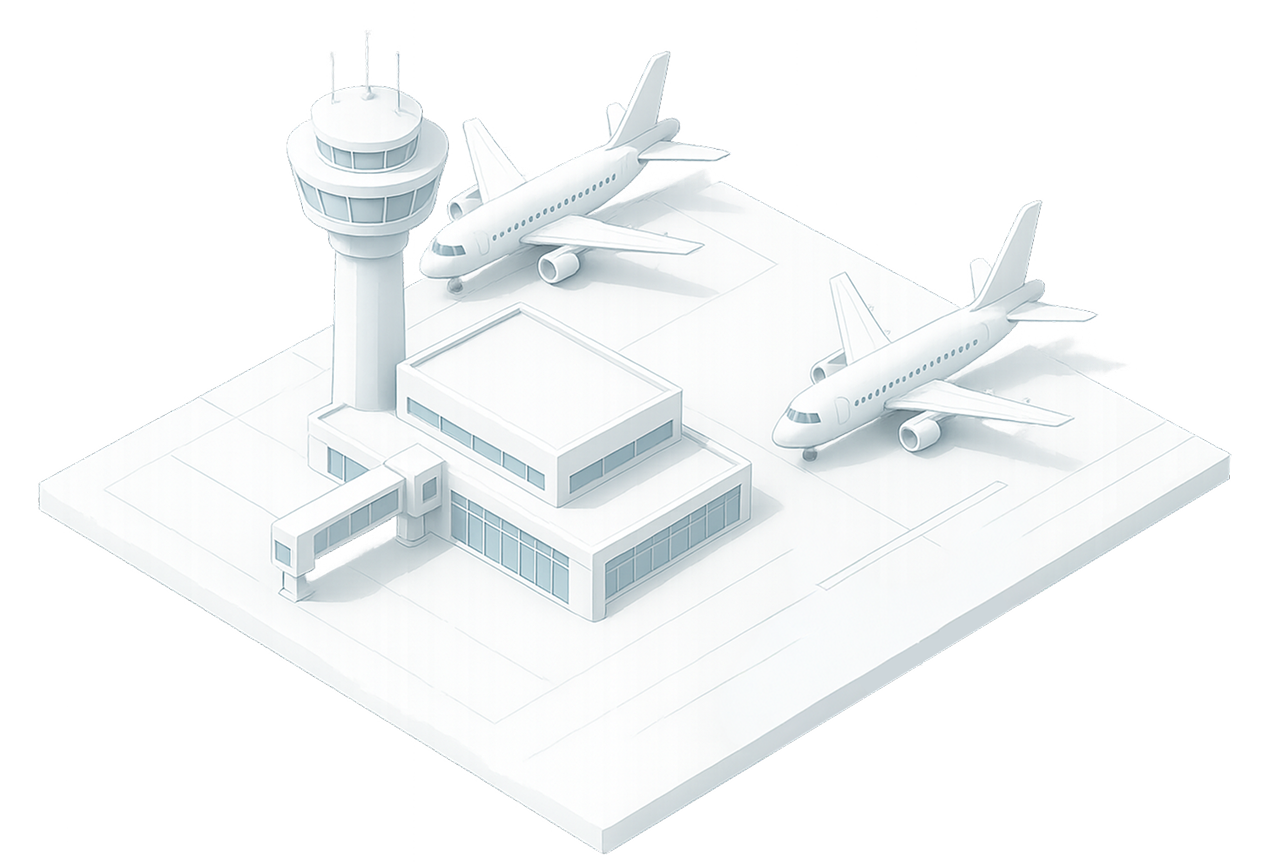
Frankfurt Airport (FRA) is located 7 miles southwest of central Frankfurt. It serves as Germany’s primary international gateway and a major European transit hub, connecting intercontinental and regional flights.
50.0379, 8.5622
Growth Trend
Passenger traffic increased by 4.1% year-over-year in August 2025, with cargo volumes up 4.4%.

Employment
81,000
Employees include airline staff, ground handling, security, retail, logistics, and airport operations personnel.
Global Ranking
Market Share of Major Airlines
Capacity Expansion
Ongoing terminal expansions and apron upgrades are increasing passenger and cargo handling capacity to meet rising demand.

Technological Advancements
Deployment of biometric boarding, automated baggage handling, and AI-driven traffic management enhances efficiency and security.
Sustainability Initiatives
Frankfurt Airport is investing in sustainable aviation fuels, electrification of ground vehicles, and energy-efficient infrastructure.

Latest News & Updates
Recent developments and updates for Frankfurt Airport.
Frankfurt Airport Sees Record Passenger Numbers in June
Frankfurt Airport reported a significant increase in passenger numbers for June, marking a record-breaking month with over 7.3 million travelers passing through. This surge is attributed to strong demand for both leisure and business travel.
Fraport Announces Further Expansion Plans for Frankfurt Airport
Fraport, the airport operator, has unveiled plans to expand Terminal 1 at Frankfurt Airport to accommodate the growing passenger volume. The expansion is expected to increase the terminal's capacity and improve passenger flow.
Frankfurt Airport Traffic Up 1.7% in June
Frankfurt Airport experienced a 1.7% increase in passenger traffic for June compared to the same period last year. This growth reflects the continued recovery of the aviation sector and increased travel demand.
Operations Logistics & Timelines
Step-by-step process transit times for passengers and cargo.
For Clients
Passenger process times from arrival to gate.
- Arrival at Terminal 1/2/315-30 mins
- Baggage Claim20-45 mins
- Passport Control (if required)15-30 mins
- Arrival Area to Security5-10 mins
- Security Check15-30 mins
- Security to Departure Terminal5-10 mins
- Departure Terminal to Gate5-15 mins
For Employees
Cargo handling deadlines and operational procedures.
- General Cargo Cut-off90 minutes pre-departure
- European Cargo Cut-off60 minutes pre-departure
- AMS (Amsterdam) Cut-off60 minutes pre-departure
- CDG (Paris) Cut-off60 minutes pre-departure
- JNB (Johannesburg) Cut-off90 minutes pre-departure
- Live Cargo Loading30-60 minutes (depending on cargo type)
- Dangerous Goods Submission48 hours pre-departure (strict)
- AWB (Air Waybill) Submission24 hours pre-departure (recommended)
- B/L (Bill of Lading) Submission24 hours pre-departure (recommended)
- ETD (Estimated Time of Departure) Confirmation48 hours pre-departure
- Palletization DeadlineVaries - Typically 24-48 hours pre-departure, depending on pallet size
- UPL (Unpacked Loose Property) DeadlineVaries - Typically 24-48 hours pre-departure, depending on volume
- Manifest Closing60-90 minutes pre-departure
- Flight Manifest Availability30-60 minutes pre-departure
- Security ScreeningVaries - Typically 1-2 hours prior to departure
- Ground Handling CoordinationContinuous - Throughout the process
- Gate AvailabilityDependent on Airline & Flight Schedule
- Baggage Handlers Cut-off60 minutes pre-departure
Passengers' Tips & Tricks
- 1
Utilize the Fast Track Security Lanes
If you have a Star Alliance, Swiss, or Lufthansa ticket, you can access the fast-track security lanes for a quicker security screening experience. Look for the designated signage upon arrival.
- 2
Explore the Terminal Options
Frankfurt Airport has multiple terminals (A, B, C, D, E, and G). Check your flight information upon arrival to determine which terminal you need to be in. Transferring between terminals is free and relatively easy via the underground system.
- 3
Take Advantage of the Baggage Delivery Service
If you're connecting flights within Frankfurt Airport, consider using the Baggage Delivery Service. Your checked luggage will be automatically delivered to your connecting flight's terminal, saving you the hassle of transporting it yourself.
- 4
Mobile App for Real-Time Information
Download the Frankfurt Airport app for real-time flight information, terminal maps, shopping and dining options, and gate changes. It's a valuable tool for navigating the airport efficiently.
- 5
Currency Exchange & ATMs
While there are currency exchange locations, they often have higher fees. ATMs within the airport terminals offer a more convenient and potentially more cost-effective option for withdrawing Euros.
Cargo Tips & Tricks
- 1
Understand Customs Regulations
Germany has strict customs regulations. Ensure all goods comply with import laws, including declarations and documentation. Incorrect declarations can lead to delays, fines, or seizure of goods. Check the German Customs website ([https://www.zoll.de/](https://www.zoll.de/)) for detailed information.
- 2
Utilize Freight Forwarder Services
Frankfurt Airport handles immense volumes of freight. Engaging a reputable freight forwarder provides expertise in customs clearance, documentation, airport navigation, and handling logistics. They can significantly streamline the process.
- 3
Plan for Security Screening & Handling Times
FRA's cargo security procedures are rigorous. Allow ample time for customs inspections, security checks, and loading/unloading operations. Peak periods can significantly extend processing times.
- 4
Proper Packaging & Labeling is Crucial
Ensure all cargo is securely packaged to withstand handling and transit. Accurate and compliant labeling (including HS codes, destination information, and shipper/consignee details) is mandatory for efficient processing.
- 5
Consider Airport Logistics & Connections
Frankfurt Airport is a major European transit hub. Plan your cargo's onward connections carefully to minimize transit time and potential disruptions. Check for rail and road connections for efficient ground transport.
Tools & Resources
Essential tools, portals, and resources for clients and partners.
Data & Reports
Official statistics, research reports, and data tracking for Frankfurt Airport.
Fraport Traffic Figures - Fraport AG
Provides the latest traffic figures for Frankfurt Airport and the Fraport Group, including comprehensive statistics and developments from recent years.
Frankfurt Airport (FRA) & Passenger Statistic 2025
Details passenger and flight statistics for Frankfurt Airport, ranking it as the 6th busiest airport in Europe and 23rd worldwide.
Fraport Traffic Figures: Frankfurt Airport Returns to Growth in Second ...
Reports on Frankfurt Airport's traffic growth in June 2025, including passenger numbers and cargo volumes.
Fraport Traffic Figures: Frankfurt Airport Returns to Growth in Second ...
Provides data on cargo volumes at Frankfurt Airport, including a year-on-year decrease in June 2025 and total cargo volume for the first half of the year.
Fraport reports 6.2% growth in cargo volumes for 2024
Details Fraport's cargo volume growth in 2024 at Frankfurt Airport, with a total of 2.1 million metric tons and a 6.2% increase.
Location & Maps
Find Frankfurt Airport on popular mapping services.
Interactive Map
Map Legend
Loading Google Maps...
Frequently Asked Questions
Common inquiries about operations and logistics at Frankfurt Airport.
What is the typical passenger process at Frankfurt Airport, from arrival to departure?
Passengers arriving at Frankfurt Airport typically proceed through security screening, then to baggage claim (if applicable), and finally to the departure terminal. Passport control is usually located after security. Customs is located further along the terminal. The process can vary slightly depending on your nationality and destination, so it's always best to check the official FRA website for the most up-to-date information and specific requirements. Allow ample time for the entire process, especially during peak hours.
How does cargo handling work at Frankfurt Airport?
Frankfurt Airport is one of the world's busiest cargo hubs. Cargo handlers (primarily Lufthansa Cargo and other independent handlers) operate within designated areas of the airport, handling the loading, unloading, sorting, and storage of cargo shipments. The airport uses a sophisticated system of automated loading lanes and ULD (Unit Load Device) management to ensure efficient and secure cargo flow. Customs clearance for cargo is handled separately from passenger customs.
What transportation options are available to and from Frankfurt Airport?
Frankfurt Airport is extremely well-connected. Public transport options include the S-Bahn (suburban train) lines S8, S9, and S11 which connect directly to the city center and surrounding areas. There are also numerous bus lines. Taxi stands are readily available, and rental car companies are located within the airport. Long-distance trains (ICE) connect Frankfurt to major cities across Germany and Europe.
Frankfurt Airport has a 'Green Mile' – what is it and why is it significant?
The 'Green Mile' is a 3.3 kilometer (2.1 mile) stretch of road along the A3 motorway that connects Frankfurt Airport to the city center. It’s significant because it’s specifically designated as a low-emission zone. Vehicles exceeding certain emission standards are prohibited from driving on the Green Mile, contributing to improved air quality in the city and reflecting FRA's commitment to environmental sustainability.
For More Info
Third-party resources, government portals, ratings, and more.
